
Table of Contents
ToggleWhat Your Concrete Home Builder Probably Never Mentioned
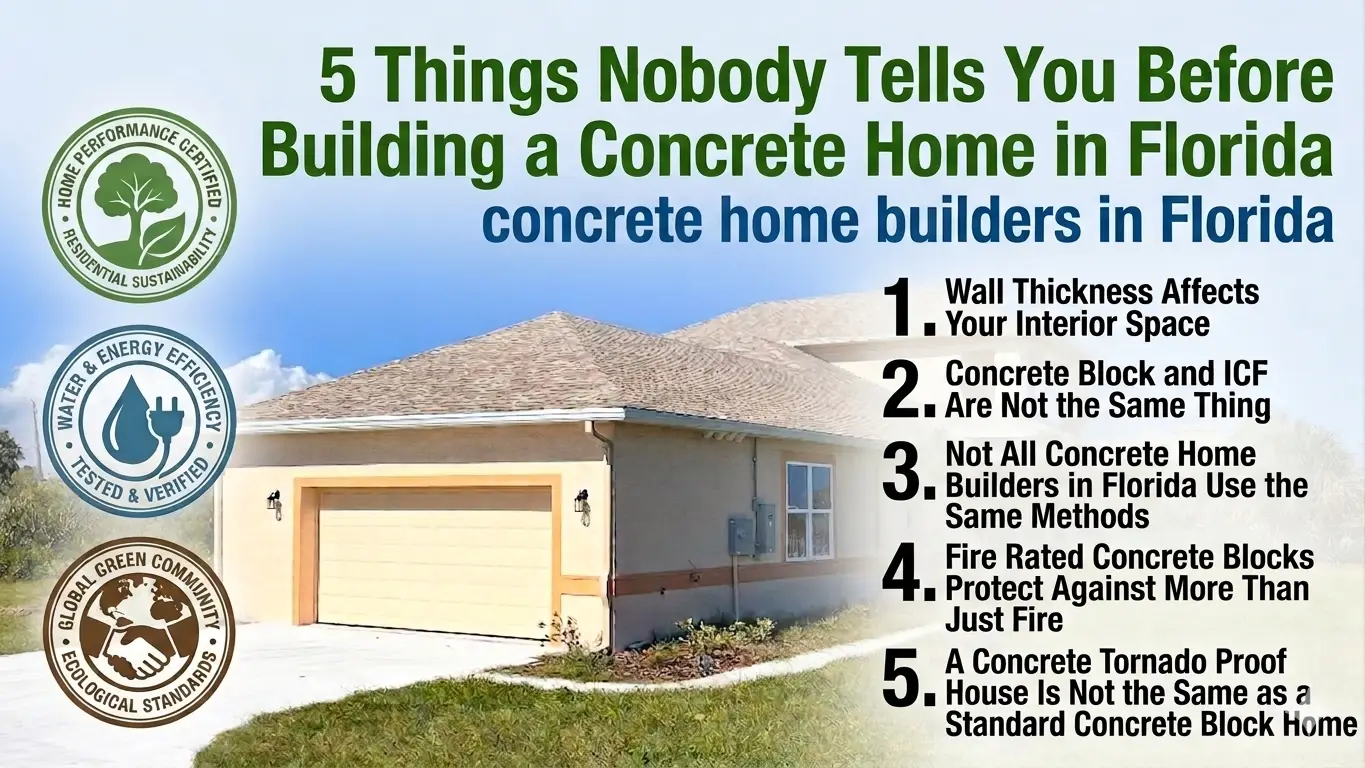
You have done your research. You know you want something stronger than wood frame. You have looked at concrete home builders in Florida and you are getting close to making a decision. But here is the thing: there are a few details that almost never come up in a sales conversation that can seriously affect how happy you are with the final result. This article covers five of them.
1 – Wall Thickness Affects Your Interior Space More Than You Think
Concrete homes in Florida are built with walls that are significantly thicker than standard wood-frame walls. A typical wood-frame wall runs about 4 to 6 inches thick. A concrete block wall runs 8 to 10 inches. An ICF wall can reach 10 to 12 inches from exterior face to interior face.
On a large custom home this barely registers. But on a smaller floor plan, every wall adds up, and the interior square footage you actually live in can be noticeably less than what the plan shows on paper.
What to check before finalizing your floor plan:
- Ask your builder to show you interior dimensions after wall thickness is accounted for
- Pay close attention to hallways, bathrooms, and smaller bedrooms where wall thickness matters most
- Larger open-plan living areas are less affected than rooms with multiple surrounding walls
- A good builder will flag this during the design phase, not after the foundation is poured
2 – Concrete Block and ICF Are Not the Same Thing
This is one of the most common points of confusion among buyers researching concrete homes in Florida. Standard concrete block, also called CMU or cinder block construction, uses hollow masonry units stacked and sometimes filled with grout and rebar.
Meanwhile, ICF construction uses foam blocks filled entirely with reinforced concrete, with the foam staying in place permanently as insulation. The structural and thermal performance of these two systems is very different, and many buyers only discover this after they have already chosen a builder.
Key differences between concrete block and ICF:
- Standard concrete block walls have limited insulation value without added exterior or interior insulation layers
- ICF walls have continuous foam insulation on both sides built permanently into the wall system
- ICF walls are airtight in a way that standard concrete block walls are not by default
- ICF outperforms concrete block significantly on energy efficiency and noise reduction
- Both are stronger than wood frame, but ICF delivers a meaningfully higher level of performance.
3 – Not All Concrete Home Builders in Florida Use the Same Methods
Just because a builder works with concrete does not mean they all build the same way. Some concrete home builders in Florida use standard CMU block with minimal insulation upgrades. Others build with ICF but without following through on air sealing, moisture control, or certified mechanical systems.
A few, like Florida Green Building Construction, build with ICF and layer independent green certifications on top, including EPA Energy Star, EPA Indoor airPLUS, and FPL BuildSmart. The label “concrete home builder” covers a very wide range of actual quality levels.
Questions to ask any concrete builder before you sign:
- Do you build with ICF or standard concrete block, and what is the difference in your process?
- What insulation R-value do your walls achieve after construction is complete?
- Do your homes carry any independent third-party certifications for energy or health performance?
- Who does your final inspections and are they independent from your own team?
- Can you show me completed homes and documented utility bills from current homeowners?
4 – Fire Rated Concrete Blocks Protect Against More Than Just Fire
Most buyers assume fire resistance is about protecting the home during a kitchen fire or a nearby wildfire. And it does do that. But fire rated concrete blocks in FL also provide a secondary benefit that is rarely talked about: they significantly slow the spread of structural damage during a fire event, which directly affects your insurance claim outcome and your ability to rebuild quickly.
A home where the fire was contained to one area because of fire-rated wall construction is a very different situation from a wood-frame home where fire travels rapidly through wall cavities and attic spaces.
What fire rated concrete blocks in FL actually protects against:
- Fire spreading from room to room through unprotected wall and ceiling cavities
- Total structural loss in a fire event compared to partial damage that is repairable
- Neighboring structure fires spreading to your home through shared walls or close proximity
- Wildfire embers entering the home through gaps in a non-rated wall or soffit system
- Higher insurance premiums that come with lower fire resistance ratings on standard builds
5 – A Concrete Tornado Proof House Is Not the Same as a Standard Concrete Block Home
This is the point that surprises buyers most. Not every concrete home qualifies as a genuine concrete tornado proof house. A standard concrete block home is stronger than wood frame, yes.
But a truly concrete tornado proof house requires continuous reinforced concrete walls, a sealed and rated roof-to-wall connection, impact-resistant openings, and an airtight building envelope that prevents the pressure differential that causes so much structural damage during a tornado. Without all of these elements working together, the concrete label alone does not guarantee tornado resistance.
What separates a genuine concrete tornado proof house from a standard block build:
- Continuous reinforced concrete walls with no gaps or weakly bonded sections
- A roof-to-wall connection system that is engineered and rated for uplift resistance
- Impact-resistant windows and doors that maintain the building envelope under pressure
- An airtight sealed envelope that prevents dangerous internal pressure buildup during a storm
- Independent structural testing or certification that confirms the home meets wind resistance standards
Ready to Build the Right Way?
Building a concrete home in Florida is one of the smartest decisions you can make for your family’s long-term safety and financial wellbeing. But the details above show that not all concrete home builders in Florida deliver the same result.
Florida Green Building Construction builds ICF homes across Flagler, St. Johns, and Volusia Counties with fire rated concrete blocks in FL standards, full green certification, and a construction process that is transparent from the first meeting to move-in day. Contact the team today to schedule your free consultation.
Frequently Asked Questions (FAQs)
Are concrete homes in Florida more expensive to build than wood-frame homes?
Yes, the upfront cost is higher. But most homeowners recover the difference within 5 to 7 years through lower energy bills, reduced insurance premiums, and fewer storm-related repair costs over time.
What is the difference between ICF and standard concrete block construction?
ICF walls are filled entirely with reinforced concrete and have permanent foam insulation on both sides. Standard concrete block has limited insulation value and is not as airtight or energy-efficient as ICF construction.
Does wall thickness in a concrete home reduce my usable interior space?
It can, especially in smaller homes under 1,500 square feet. A good builder will account for wall thickness during the design phase so your actual interior dimensions are clear before construction begins.
What do fire rated concrete blocks in FL actually protect against?
They slow fire from spreading through wall cavities, reduce total structural loss during a fire event, and help contain damage to one area. They also lower your insurance premiums by improving your home's fire resistance rating.
Does a concrete home automatically qualify as a tornado proof house?
Not automatically. A genuine tornado-resistant home needs continuous reinforced walls, a rated roof-to-wall connection, impact-resistant openings, and a fully sealed building envelope working together as one complete system.
How do I know if a concrete home builder in Florida is actually building to a high standard?
Ask for third-party certifications like EPA Energy Star or FPL BuildSmart. Independent certifications mean an outside agency tested and verified the home's performance, not just the builder's own word.
Can I customize my floor plan when building a concrete ICF home?
Yes, fully. Florida Green Building Construction offers 41 pre-designed ICF floor plans that are all adjustable. You can also bring your own plans or design something entirely new with their team.