
Building a custom home is a journey filled with endless choices—granite or quartz, tile or hardwood, open concept or traditional layout. But as Norbert Sluzewski, Principal of Consulting Leaders Group, LLC, discovered, the most critical decision isn’t about what you see on the surface. It is about what protects you when the sky turns dark.
When Norbert and his family decided to relocate from the Northeast to the beautiful coast of Florida, they were met with a common warning from friends and family: “Watch out for the hurricanes.”
Instead of ignoring the risk, Norbert tackled it with the analytical precision of a business consultant. His journey to building a home in Seaside Landings, Flagler Beach, serves as a perfect case study for why savvy homeowners are choosing Florida Green Building Construction and Insulated Concrete Forms (ICF).
Table of Contents
ToggleThe Elimination Round: Why Wood Was Never an Option
For many relocating to Florida, the reliance on a builder’s standard “package” often leads to a wood-frame house. For Norbert, this was a non-starter.
“When we moved… everyone cautioned us about the hurricanes,” Norbert recalls. “So naturally, we wanted to acknowledge that reality and make sure we would feel safe in our new home. In doing our research, we immediately discounted any variants of a house built out of wood frame.”
He recognized early on that in a waterfront environment, a structure built of lumber simply could not offer the peace of mind his family required.
The "Water Dam" Comparison
This left two contenders: the traditional concrete block construction common in Florida, and the advanced ICF (Insulated Concrete Forms) method specialized in by Florida Green Building Construction.
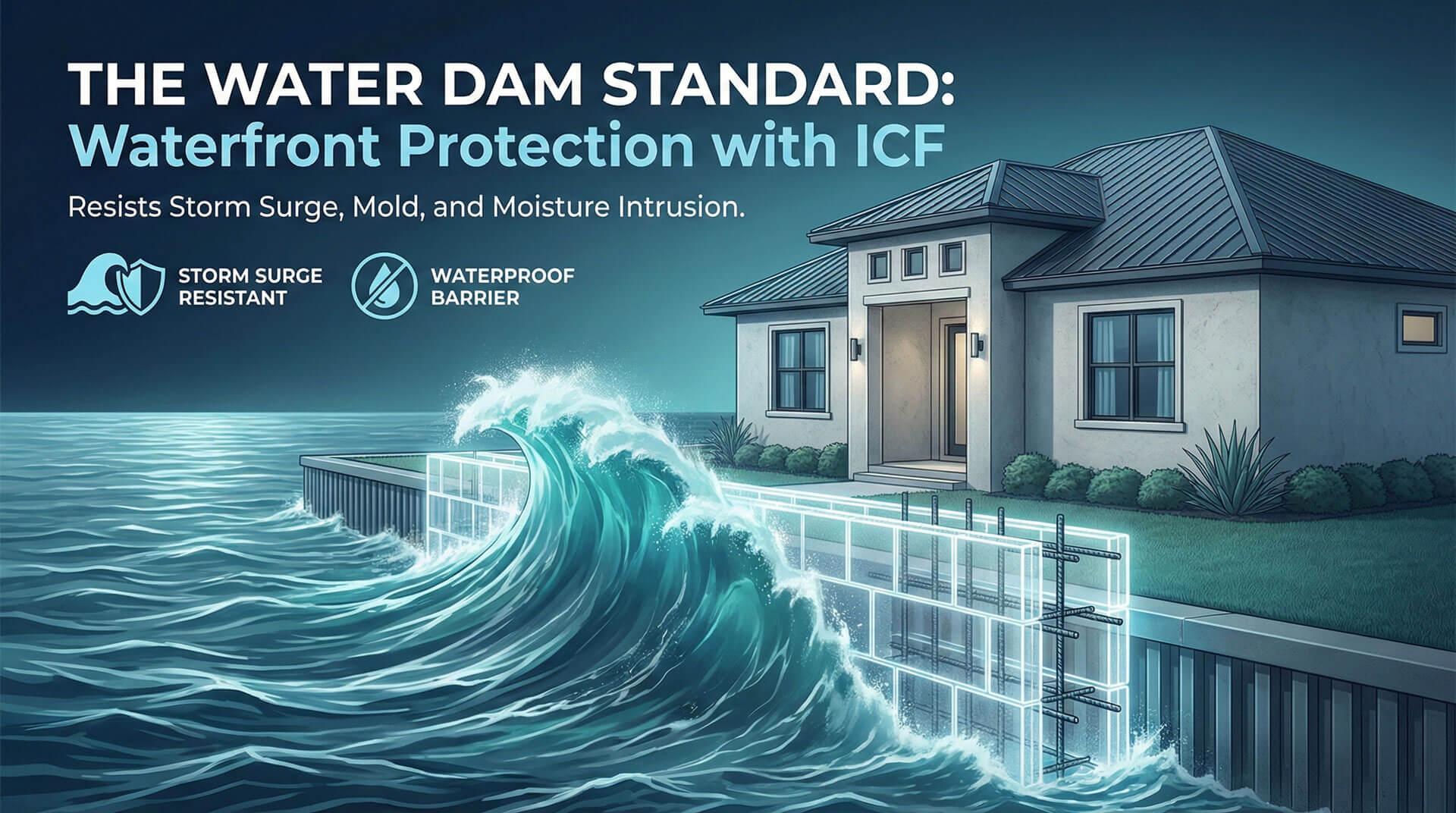
Norbert’s description of ICF is perhaps one of the most powerful analogies we have heard. He realized that an ICF home is built using a “rebar-reinforced concrete poured frame, not unlike how major water dams are built, to exhibit extraordinary strength and endurance.”
By choosing ICF, he wasn’t just building a house; he was building civil infrastructure capable of withstanding nature’s fury.
The Analysis: Value vs. Cost
As a consultant, Norbert weighed the variables. How did ICF stack up against standard concrete block?
Resiliency & Durability: ICF Won.
Energy Efficiency: ICF Won.
Insurability & Credits: ICF Won.
“The only exception was cost,” Norbert notes honestly. “Which for an ICF home was somewhat, but not extraordinarily higher than for a concrete block construction.”
This is the crucial calculation that many homebuyers miss. While the initial sticker price of ICF might be slightly higher, the long-term value—lower energy bills, significantly lower insurance premiums, and the priceless value of safety—makes it the superior financial choice.
A Prudent Investment
Today, as his waterfront home in Flagler Beach nears the finish line, Norbert looks at his project not just as a place to live, but as a smart allocation of resources.
“We are confident we made a prudent investment in a waterfront home that we expect will serve us well for many years to come,” he says.
At Florida Green Building Construction, we are proud to be the partner that helps homeowners like Norbert turn their demand for safety into a reality. You don’t have to settle for the standard. You can build a fortress.