
If you are planning to build your forever home in Florida—especially along the beautiful coasts of Palm Coast, Flagler Beach, or St. Augustine—you are likely excited about the lifestyle. You are picturing sunny mornings on the lanai and afternoons near the water.
But if you’ve spent any time reading local forums, talking to neighbors, or watching the news lately, there is a massive elephant in the room: the Florida property insurance crisis.
As we head through the volatile weather and summer heat of 2026, homeowners with traditional wood-frame and older block homes are facing skyrocketing premiums, unexpected non-renewals, or are being forced onto Citizens Property Insurance (the state’s insurer of last resort).
It begs the question for anyone planning a new build: Does building with Insulated Concrete Forms (ICF) actually make your home easier and cheaper to insure in Florida?
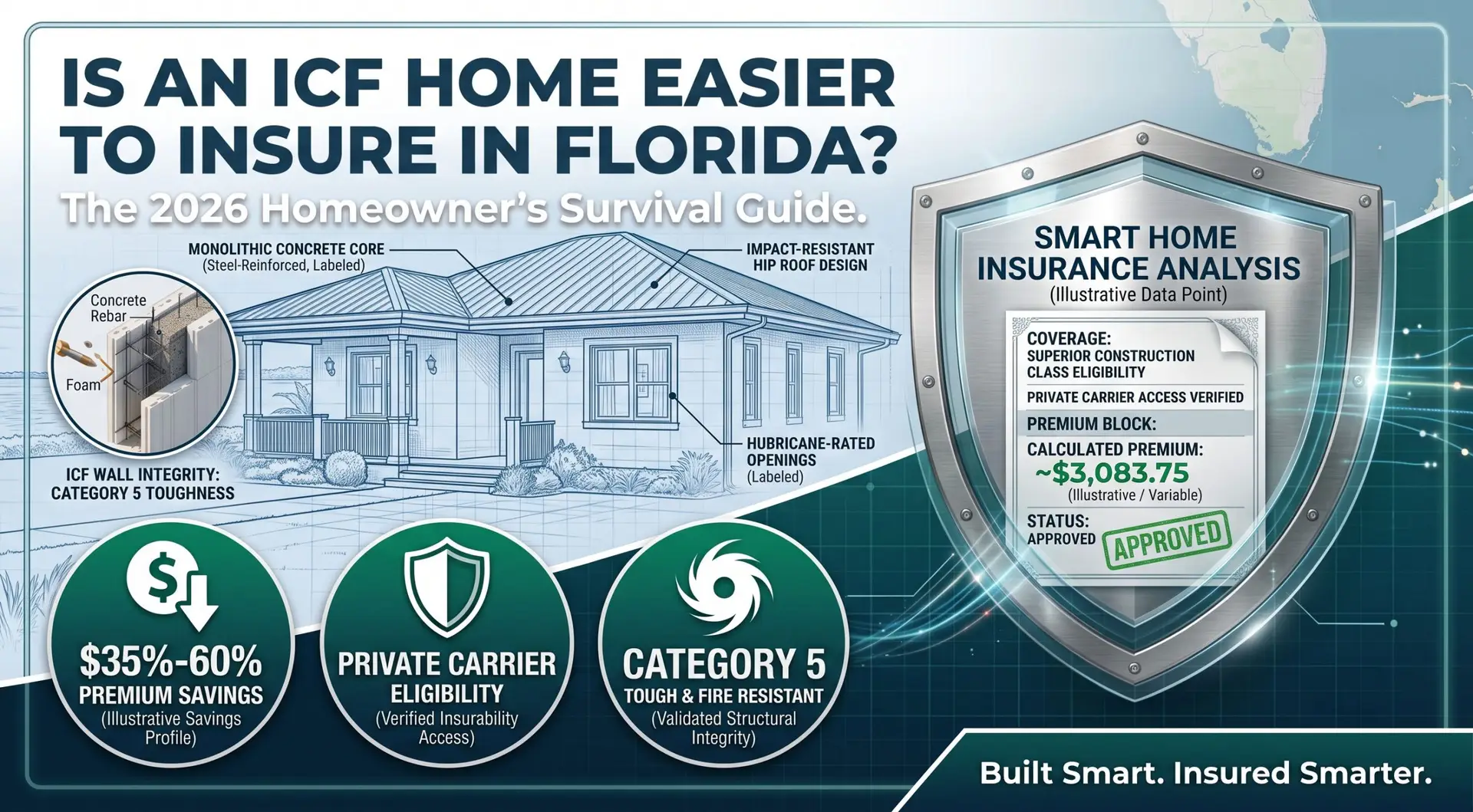
Yes. Insulated Concrete Form (ICF) homes are significantly easier and cheaper to insure in Florida. Because ICF structures utilize a monolithic, steel-reinforced solid concrete core sandwiched between double-sided high-density foam, they are classified as “Superior Construction” (Class 6) by insurance underwriters. This classification, paired with wind-mitigation features like impact-resistant glass and a hip roof, allows Florida homeowners to secure premium discounts of 35% to 60% compared to traditional wood-frame homes, while guaranteeing long-term insurability from private carriers.
The Insurance Core Problem: Why Traditional Homes are Failing
 To understand why insurance companies favor ICF, you have to look at what they are afraid of. Insurance is entirely a game of risk management.
In coastal Florida, carriers look at three primary risk factors when calculating your premium (or deciding to drop you entirely):
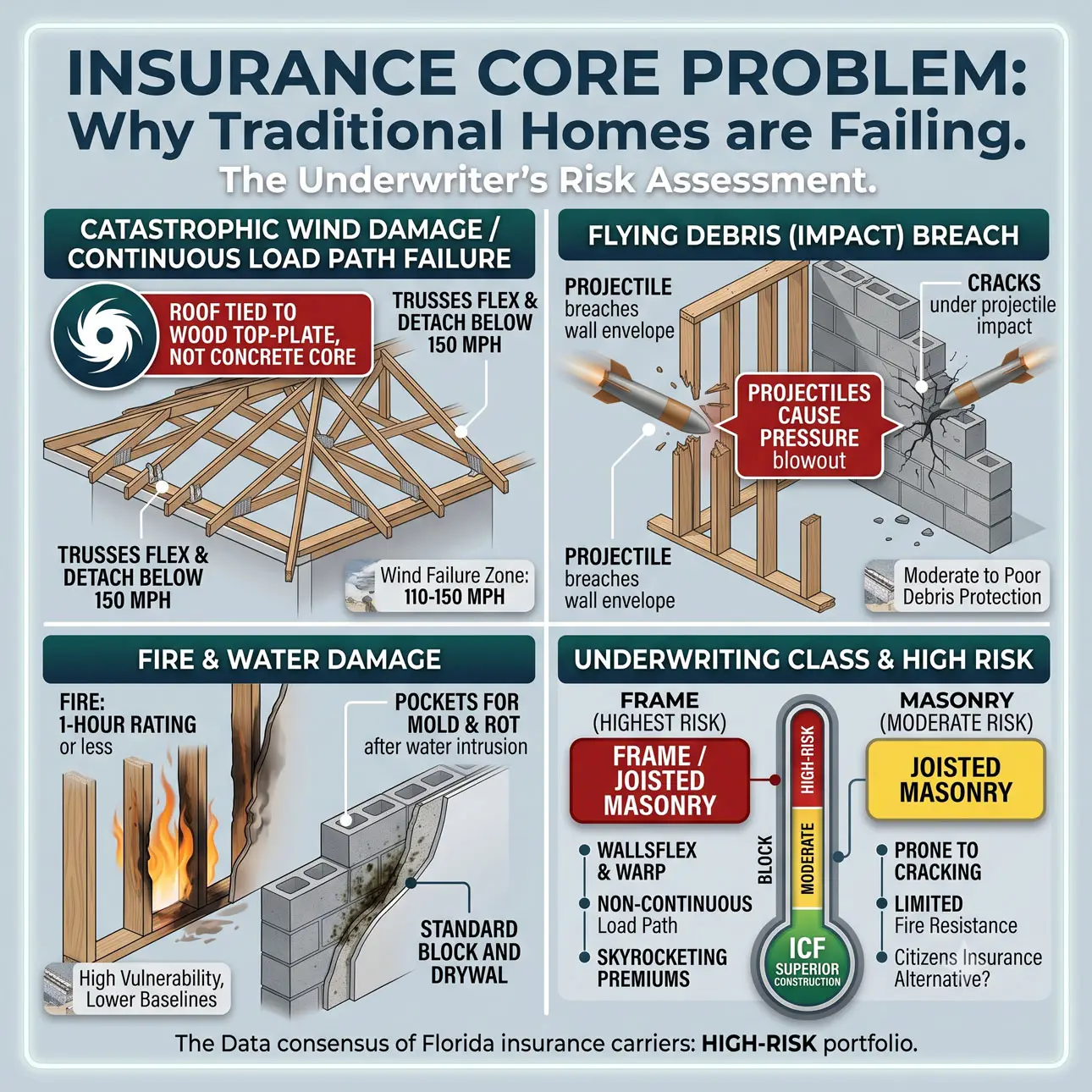
- Catastrophic Wind Damage: Will a Category 4 or 5 hurricane tear the roof off or collapse the walls?
- Flying Debris (Impact): Will airborne debris breach the envelope, causing rapid pressurization and structural blowout?
- Fire & Water Damage: How quickly will the structure succumb to fire, or harbor mold and rot after water intrusion?
Standard wood-frame homes flex, warp, and can experience complete structural failure in major wind events. Even standard hollow cinder block homes are prone to cracking under extreme hydrostatic pressure or projectile impact.
Because of this, private insurance carriers are aggressively shedding older or wood-framed risks from their portfolios. Insurability is no longer a given in Florida—it is a premium feature.
How ICF Construction Solves the Florida Insurance Crisis
Building a custom home with Florida Green Building Construction utilizing Insulated Concrete Forms fundamentally changes your risk profile in the eyes of insurance underwriters.
Here is the technical breakdown of why carriers reward ICF construction:
1 – The “Superior Construction” Underwriting Class
Insurance companies do not evaluate all masonry homes the same way. In underwriting guidelines, construction is classified into tiers. Traditional hollow concrete block with wood roof-framing is often classified as “Joisted Masonry.”
However, a home constructed with ICF is classified as Superior Construction or Fire-Resistant Masonry. Because the concrete core is solid, continuous, and reinforced heavily with steel rebar, underwriters view it as a commercial-grade structure. This classification automatically triggers lower baseline premium rates.
2 – Maximum Wind Mitigation Credits
Florida law requires insurance companies to offer discounts (credits) for homes built with specific wind-resistant features. These are evaluated via a Wind Mitigation Inspection.
When you build an ICF home with a wind-mitigated roof envelope, you automatically secure the highest possible tier of credits:
| Construction Feature | Traditional Wood Frame | Standard Cinder Block | FGBC Custom ICF Home |
| Wall Construction Class | Frame (Highest Risk) | Joisted Masonry | Superior Masonry (Lowest Risk) |
| Wind Resistance Rating | Up to 110-120 MPH | Up to 130-150 MPH | 200+ MPH (Category 5 Tough) |
| Debris Impact Protection | Poor (Easily breached) | Moderate (Prone to cracking) | Exceptional (Missiles bounce off) |
| Fire Resistance Rating | 1 Hour or Less | 1 to 2 Hours | Up to 4 Hours |
| Average Insurance Discount | 0% (Baseline) | 15% – 25% Discount | 35% – 60% Discount |
3 – The Continuous Load Path Benefit
The most common cause of complete home destruction during a hurricane is the roof lifting off the walls. Traditional builders use simple metal clips nailed into wood top-plates.
In our ICF builds, heavy-duty steel hurricane straps are embedded directly into the solid poured concrete core of the walls, anchoring the engineered roof trusses. This creates a continuous load path from the foundation to the peak of the roof, transforming the entire home into a single, cohesive unit that wind cannot easily tear apart.
The Real Math: What Do You Save?
 Let’s look at a realistic financial comparison for a typical $500,000, 2,500-square-foot new construction home in the Palm Coast/Flagler Beach area in 2026:
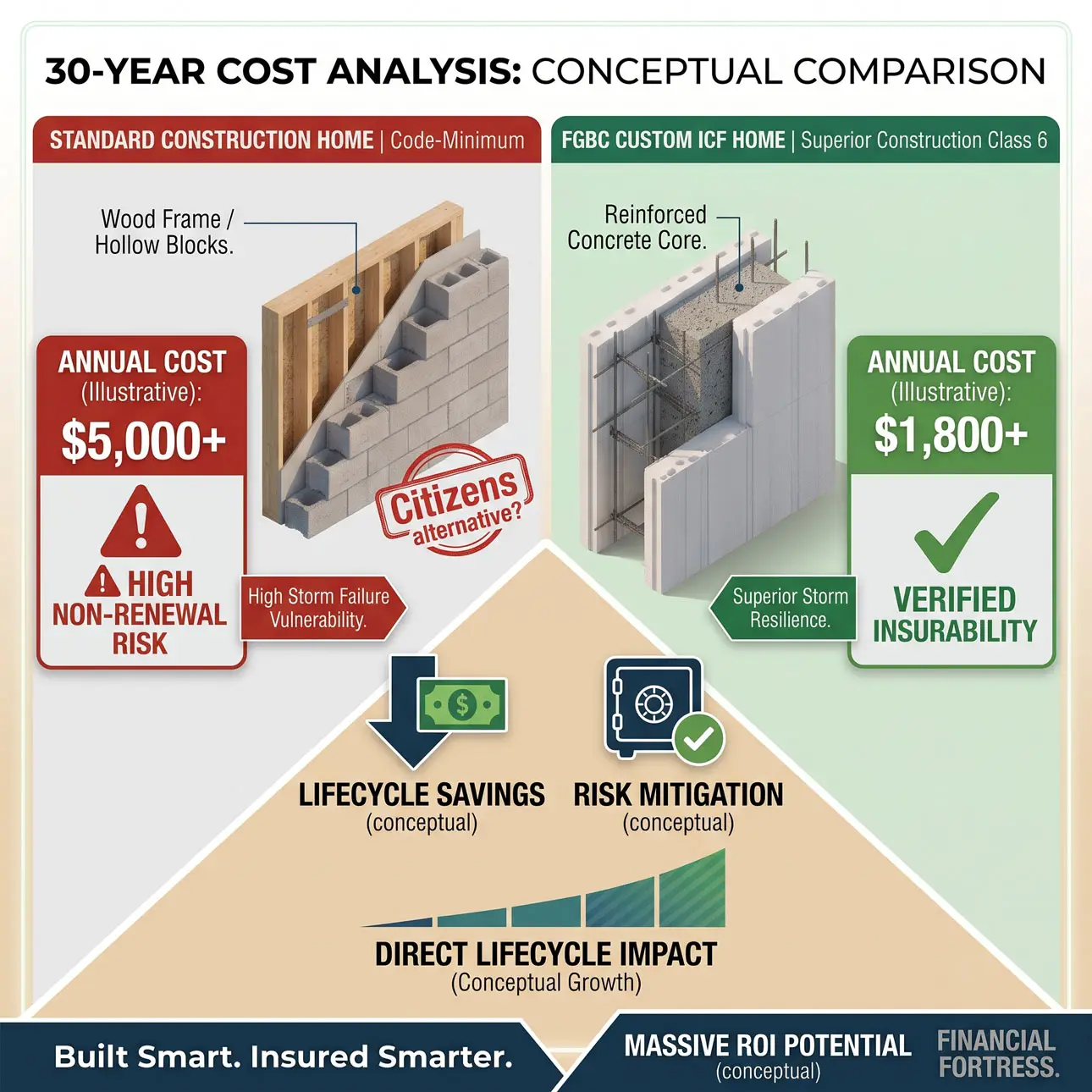
- Standard Wood-Frame/Code-Minimum Home:
- Estimated Annual Insurance Premium: $4,500 – $6,500+
- Risk of Non-Renewal: High over a 10-year period.
- Florida Green ICF Custom Home:
- Estimated Annual Insurance Premium: $1,500 – $2,200
- Risk of Non-Renewal: Extremely Low (Private carriers actively compete to insure low-risk concrete assets).
The “Hidden Mortgage” Calculation
Saving $3,000 a year on homeowners insurance is the equivalent of saving $250 a month. Over the course of a 30-year mortgage, that is $90,000 in direct savings—not counting the compound interest if you invested that money, or the massive energy savings on your monthly utility bills.
This financial return completely offsets the slightly higher upfront cost of building with ICF, making your “Fortress” a highly lucrative long-term financial asset.
Use our ICF Savings Calculator to model your exact home size and estimate your long-term return on investment.