
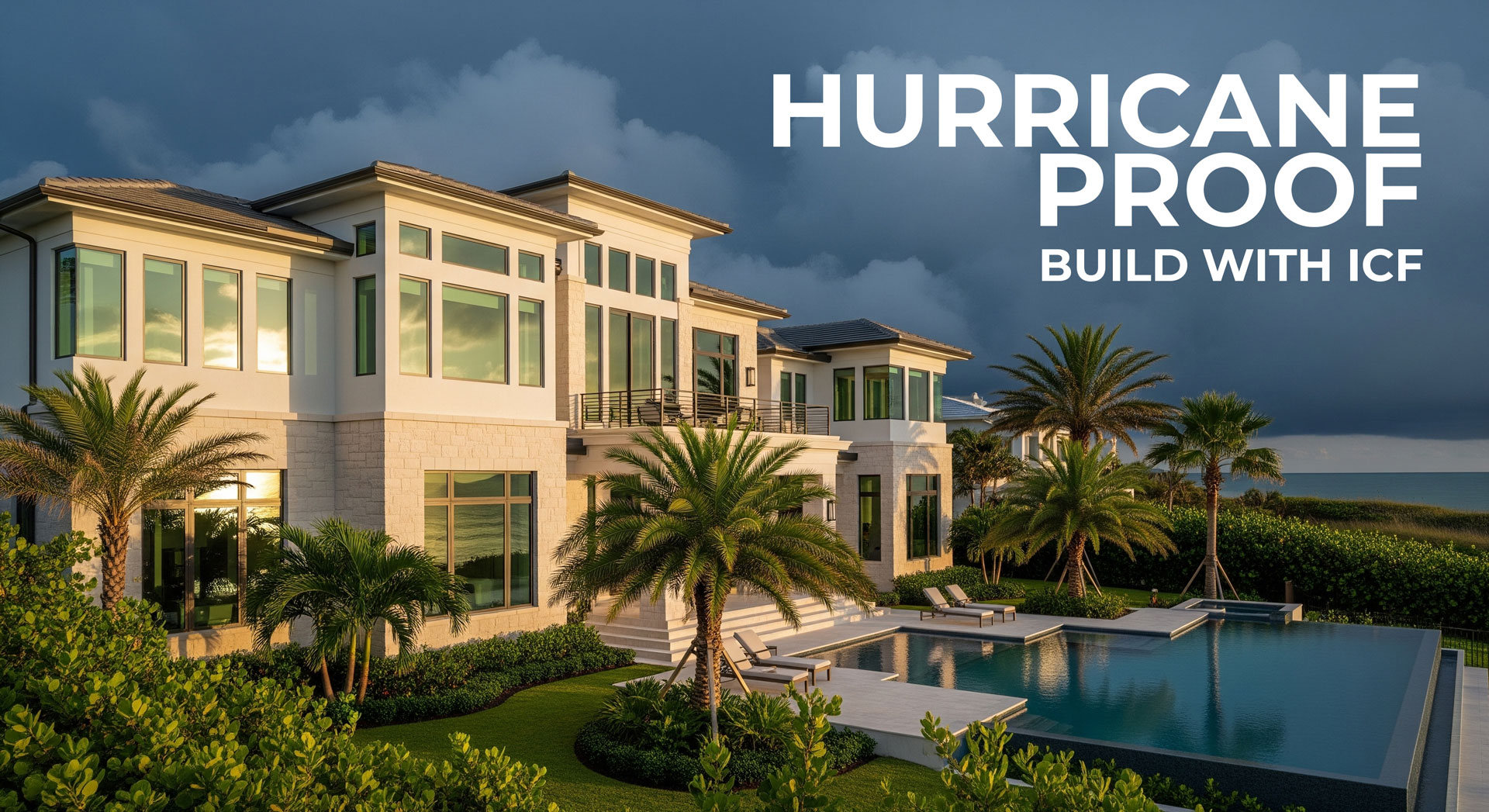
Living in Florida—especially right here on the beautiful coasts of Palm Coast, Flagler Beach, and Volusia County—is incredible. We’ve got year-round sunshine, world-class golf courses, and the Atlantic Ocean practically in our backyards. But let’s be honest: paradise has a catch, and it’s called hurricane season.
When families move down here to build their coastal dream home, the very first question I usually hear is about safety. “How do we protect our investment, and more importantly, our family, when a big storm hits?”
A lot of builders will tell you that a standard wood-frame or cinder block house built to “Florida building code” is perfectly fine. But here at Florida Green Building Construction, we look at things a bit differently. Building codes are just the bare minimum the law requires. If you want to sleep soundly during a storm, you don’t build to the minimum. You build a fortress.
If you are looking to build a truly hurricane-proof house, the secret is ICF (Insulated Concrete Forms).
Can You Actually Build a “Hurricane-Proof” House?
Now, is any house 100% immune to the absolute worst Mother Nature can dish out? No. But an ICF home gets you as close to a hurricane-proof house as humanly possible in residential construction.
Standard homes are designed to flex and hopefully hold together. ICF homes are built to stand firm. By totally rethinking what goes inside your walls, we create hurricane-resistant homes that give you unparalleled peace of mind.
What Exactly is ICF Construction?
Think about how they build commercial bank vaults or major water dams. They don’t use 2x4s and nails; they use solid, steel-reinforced poured concrete. ICF brings that exact same heavy-duty engineering to luxury custom homes.
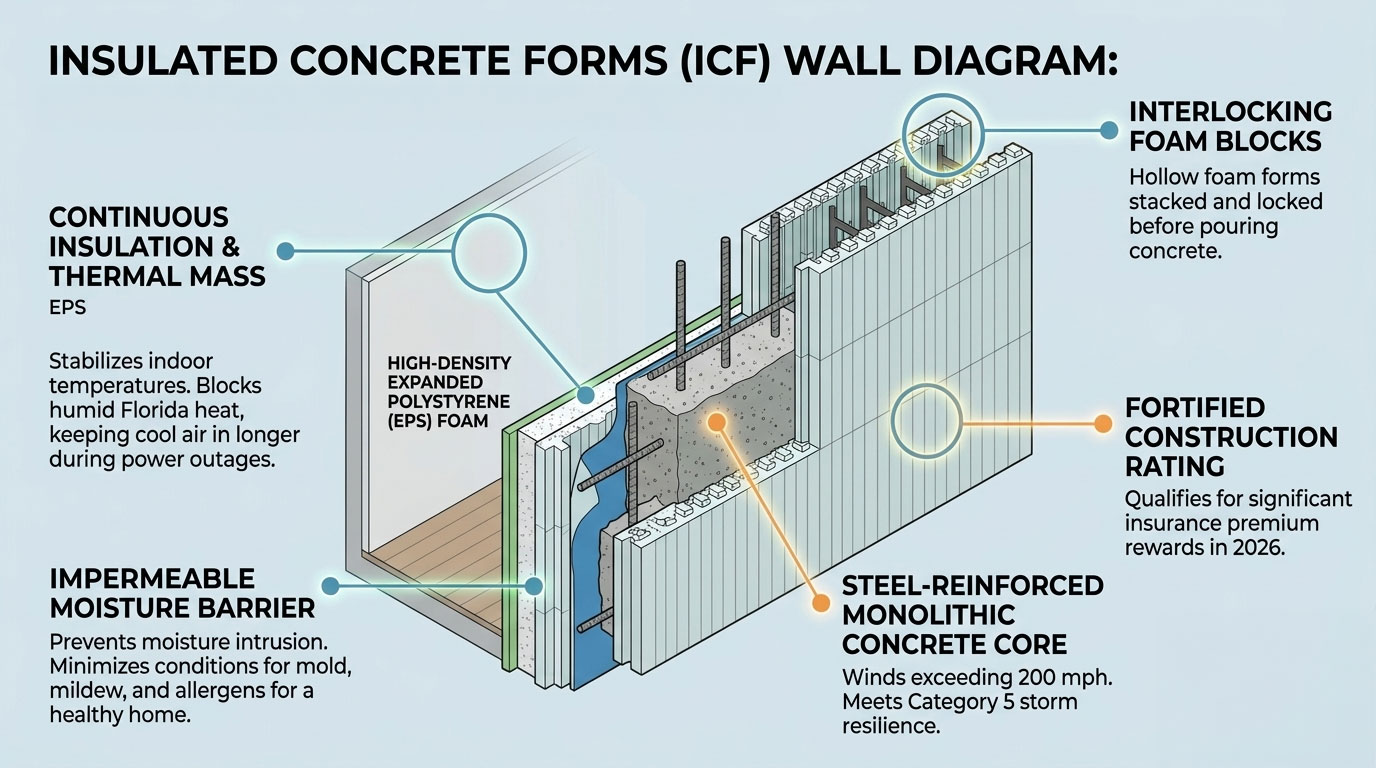
Instead of framing your house with wood, ICF uses thick, hollow blocks made of premium EPS foam insulation. We stack these blocks to shape your exterior walls, drop in a heavy grid of steel rebar, and then fill the whole thing with solid poured concrete.
What you end up with is a continuous, solid concrete wall wrapped in two thick layers of high-end insulation.
4 Ways ICF Homes Brush Off Category 5 Hurricanes
So, how does this actually translate to surviving a major storm? When you build a custom home in Florida with ICF, you are engineering a defense system against the four biggest threats of a tropical cyclone:
1. It Stands Up to 200+ MPH Winds
Traditional wood-frame homes start struggling in Category 3 winds. ICF walls, on the other hand, are engineered to take on wind speeds of 200 MPH or more—well above the threshold of a Category 5 hurricane. When the wind is howling outside, the interior of an ICF home stays incredibly quiet and perfectly still.
2. It Shrugs Off Flying Debris
In a hurricane, the wind itself isn’t the only threat; it’s the stuff blowing around in it. Testing facilities actually shoot 2×4 pieces of lumber out of cannons at 200+ MPH to see what walls can handle.
A standard wood-frame wall shatters.
A standard cinder block wall cracks and compromises the inside of the house.
On an ICF wall? The 2×4 literally bounces off the outer foam layer, leaving the concrete core completely untouched.
3. It Keeps the Roof Exactly Where It Belongs
The most vulnerable part of a house during a storm is where the roof attaches to the walls. In our high-performance ICF homes, we anchor the roof trusses straight into the solid poured concrete using heavy-duty steel hurricane straps. This creates a “continuous load path” from the roof down to the foundation, stopping extreme updrafts from tearing the roof off.
4. It Defends Against Moisture and Flooding
Coastal living means dealing with water. Wood rots, warps, and grows mold when it gets wet. But concrete and EPS foam? They’re completely inorganic. If storm surge or flooding ever happens, your ICF walls won’t lose their structural strength, and they won’t become a breeding ground for mold once the water recedes.
Beyond the Storm: The Everyday Perks of Living in an ICF Home
The best part about building an ICF home is that you don’t just feel the benefits during the few days a year a storm might hit—it pays off every single day.
Massive Insurance Discounts: Because these homes are so resilient to wind, impact, and fire (with up to a 4-hour fire rating), insurance companies absolutely love them. Our homeowners consistently see much lower property insurance premiums compared to their neighbors with standard builds.
Up to 70% Energy Savings: That thick double-insulation creates a powerful thermal mass. It locks the brutal Florida heat outside and keeps your expensive AC inside. This drastically drops your monthly utility bills and makes achieving a Net-Zero energy rating totally doable.
EPA-Certified Clean Air: Our airtight construction stops humid, allergen-heavy Florida air from sneaking in through the walls, ensuring the air your family breathes stays pristine and healthy.
Build It Right. Build It Once.
You shouldn’t have to panic, board up your windows, and evacuate your home every time a storm is in the forecast. Your home is supposed to be your ultimate safe haven.
At Florida Green Building Construction, we don’t just build houses. As Palm Coast’s premier custom home builder, we engineer high-performance, Universal Luxury homes that are designed to take care of you for life.